The $80,000-Per-Acre Question: When to Replant
Replanting is the most expensive decision a vineyard manager makes. It is also one of the least precise.
A full replant in Napa—vine removal, soil prep, new rootstock and budwood, trellis rebuild, and three to four years of lost production while the new vines come into bearing—runs $50,000 to $80,000 per acre when you account for the opportunity cost. In Oakville or Rutherford, where fruit sells for $8,000 to $12,000 per ton, three years of zero production on even a five-acre block represents a half-million-dollar hole in your revenue.
Given those numbers, you would expect replant decisions to be among the most data-driven calls in the business. They are not. Most are still made by feel.
How Replant Decisions Actually Get Made
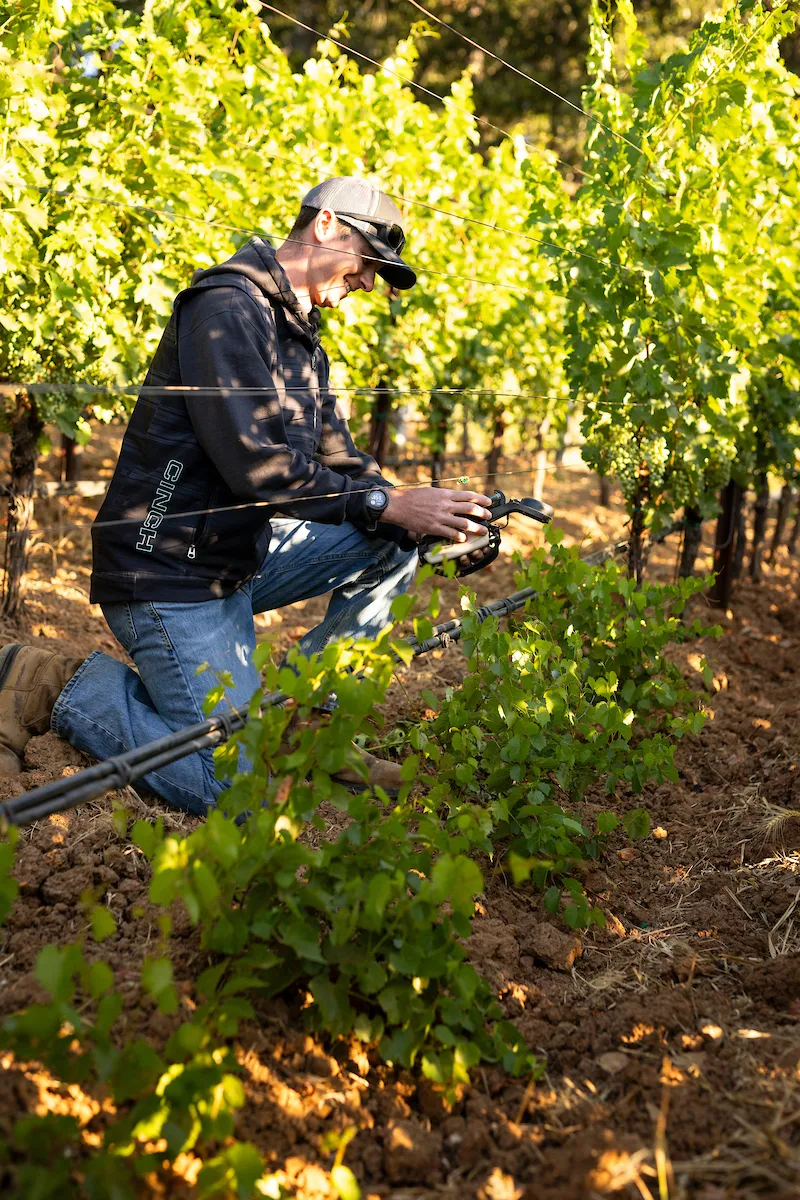
The typical process looks something like this: the vineyard manager walks a block, notes that it looks "tired," and flags it for discussion. Maybe yields have been declining for a few years. Maybe there is visible virus pressure. Maybe the vine age is pushing 25 or 30 years and the assumption is that it is time.
The estate director or owner weighs that recommendation against the budget, picks a timeline, and the block goes on the replant schedule. In many cases, the entire block gets pulled—healthy vines and declining vines alike—because partial replants are logistically awkward and the assumption is that if some vines are failing, the rest will follow.
This approach works well enough when land values are climbing and grape prices are strong. You replant, take the hit for a few years, and come back with a young, vigorous block that produces for another three decades. The economics forgive imprecision.
But in a softer market, imprecision gets expensive. And the most common form of imprecision in replant decisions is pulling vines that still have productive life.
The Problem with Block-Level Thinking
When you evaluate a block in aggregate—average yield, average vine age, general health impression—you lose the variation that actually matters. A block that averages 3.5 tons per acre might have sections producing 5 tons and sections producing 1.5 tons. The declining sections might be concentrated along a specific row where virus spread from an adjacent block, or where drainage is poor, or where a particular rootstock is underperforming.
If you pull the whole block, you are spending $50,000+ per acre to replace vines that were still producing $10,000 per ton fruit. That is not a replant decision. That is a write-off disguised as one.
The alternative—and this is where vine-level data changes the calculus—is to know exactly which vines are declining and why. Not at the block level. Not at the row level. At the individual plant.
What Vine-Level Data Shows You
When every vine has its own record—GPS coordinates, variety, clone, rootstock, planting date, virus test history, yield estimates, crew observations—the replant question changes fundamentally. Instead of "should we replant Block 7," the question becomes "which vines in Block 7 have declining health, what is causing it, and what is the cost of replacing just those vines versus nursing them through another few seasons?"
Here is what that looks like in practice:
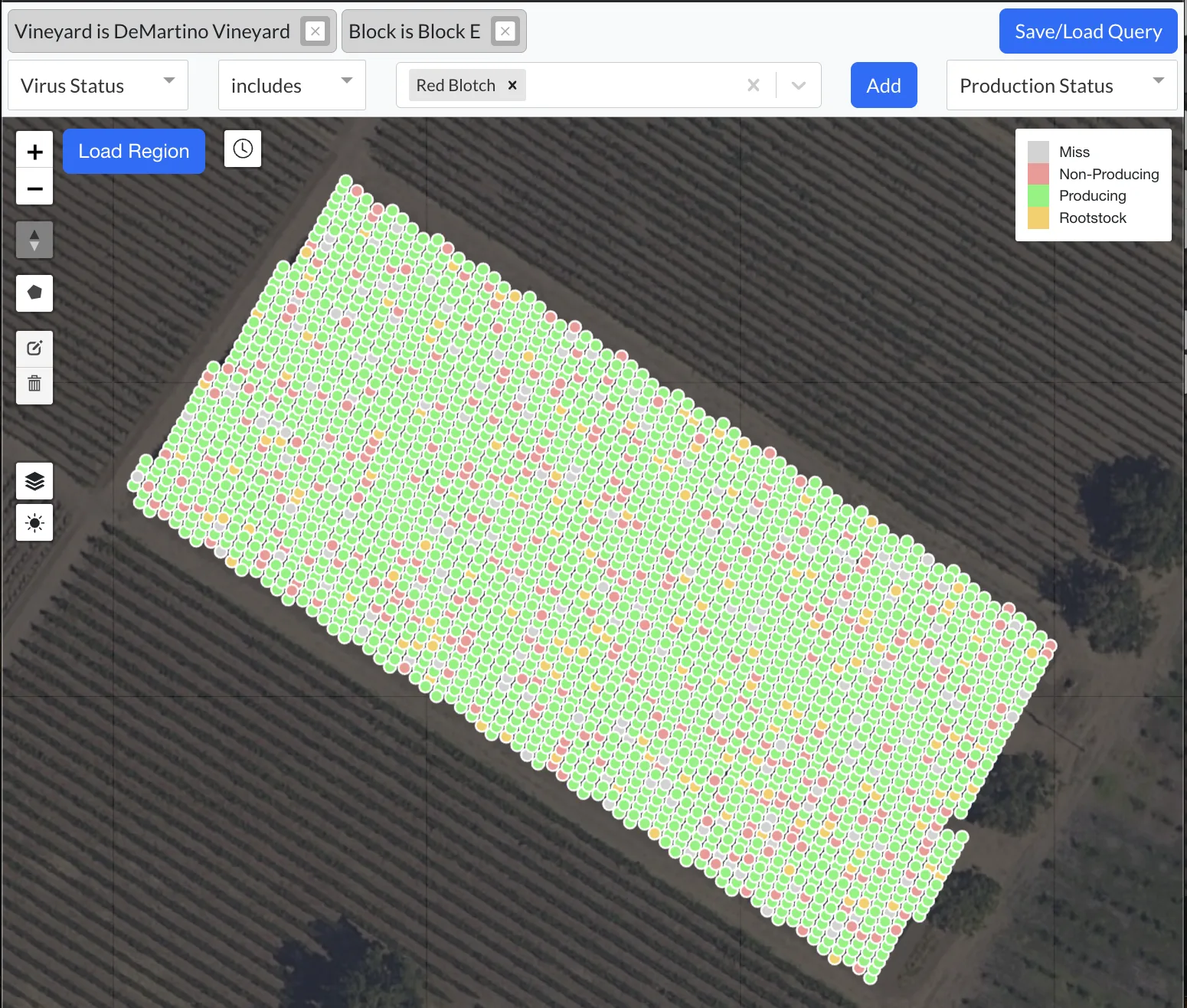
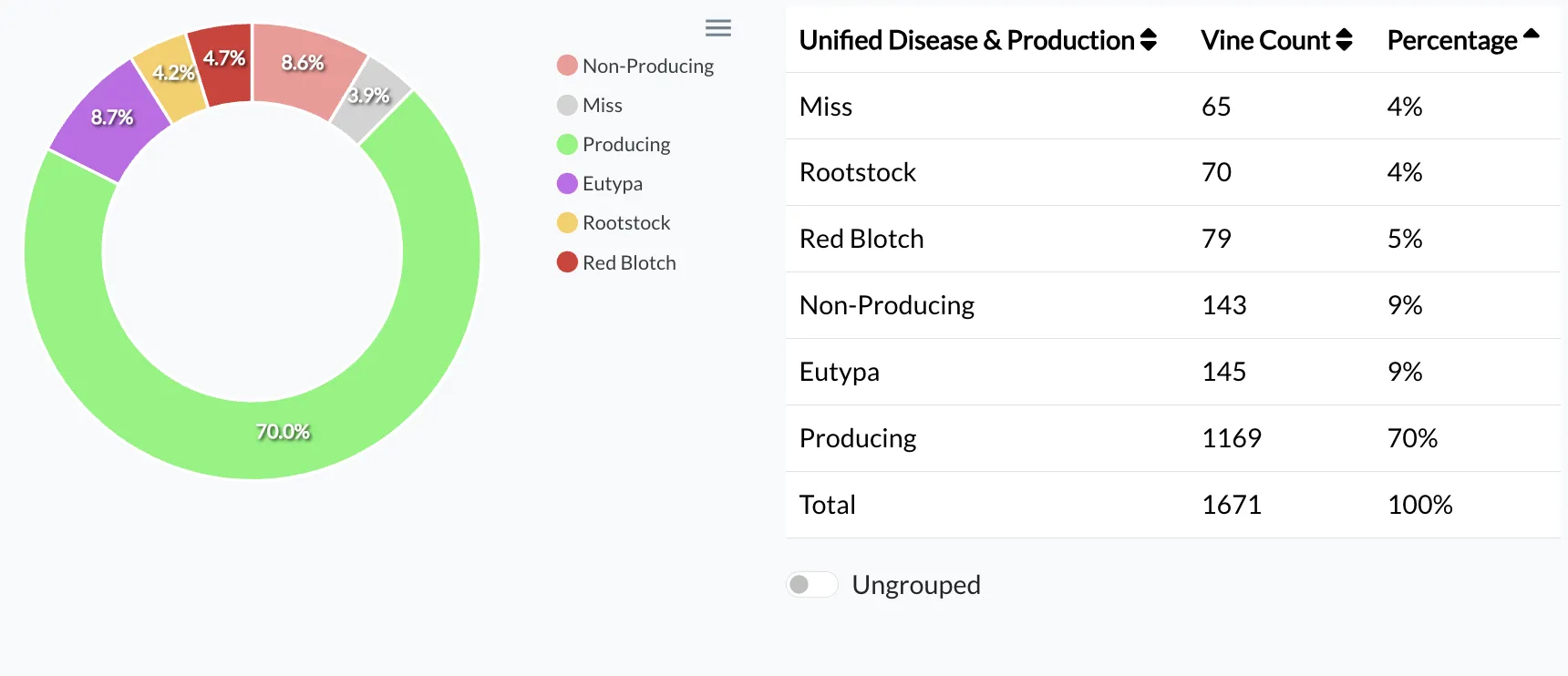
Virus mapping changes the boundary. Red Blotch and Leafroll do not spread uniformly. They follow insect vectors, row patterns, and proximity gradients. With vine-by-vine virus tracking over multiple seasons, you can see exactly where the infection front is. Maybe 30% of the block is compromised and spreading. Maybe 70% is clean and will stay clean if you remove the infected vines and replant just those sections. That is a very different economic decision than pulling 100% of the block.
Age is not the whole story. A 28-year-old vine on healthy rootstock in good soil can produce excellent fruit for another decade. A 15-year-old vine on AXR1 rootstock in a phylloxera-prone area might already be in decline. Vine-level data lets you evaluate actual performance, not just age assumptions. Some of the best fruit in Napa comes from old vines that a block-level analysis would have flagged for replanting years ago.
Partial replants become manageable. The logistical argument against partial replants—that it is too complex to manage young and mature vines in the same block—falls apart when you have a vine-by-vine management system. Your crew knows exactly which vines are new, which need establishment-phase care, and which are in full production. Work orders go to specific vines, not entire blocks. The complexity that makes partial replants impractical on paper becomes tractable with the right data layer.
The Sequence That Saves Money
The estates that handle replant decisions well tend to follow a pattern:
-
Map virus pressure vine by vine, across at least two seasons. One season shows you where the virus is today. Two seasons show you the rate and direction of spread.
-
Identify the real decline zone. Usually it is smaller than the block-level impression suggests. Sometimes significantly smaller.
-
Model the economics of partial versus full replant. If 25% of a block is compromised, the math often favors pulling just those vines, replanting in place, and keeping 75% of the block in production. The total cost is lower and the revenue gap is a fraction of a full replant.
-
Track replant success at the vine level. New plantings fail at a non-trivial rate—nursery stock quality varies, irrigation issues during establishment, gopher damage. If you are not tracking which specific replanted vines are thriving and which are struggling, you will not catch failures until they become visible, which is usually a year or two too late.
What This Means for Your Budget
The cost of vine-level data collection is measured in dollars per acre per year. The cost of a bad replant decision is measured in tens of thousands of dollars per acre. The math is not close.
More importantly, vine-level data turns replanting from a binary decision (pull the block or do not) into a spectrum of options. You can phase replants over multiple years to spread the capital cost. You can target the worst sections first and monitor whether the remaining vines stabilize. You can make the case to an owner or investor with specific data rather than a general feeling about vine health.
In a market where capital is more cautious and grape prices are under pressure, that precision is not a luxury. It is the difference between a replant program that protects long-term value and one that destroys near-term cash flow for marginal gains.
The vines you plant this year will produce fruit into the 2050s. The decision about which ones to plant—and which existing vines to keep—deserves better than a walk-through and a gut call.
<!-- related-reading -->