Why Spreadsheets are the Most Expensive Way to Map Virus
In the ever-evolving landscape of viticulture, the Red Blotch virus has presented a formidable challenge to Napa Valley's vineyards. The quest for an elusive zero-virus scenario is proving financially unattainable, with the costs of testing and replanting reaching unprecedented heights. Decision-makers are grappling with the intricacies of managing virus outbreaks, often resorting to traditional tools such as hand-drawn maps and Excel spreadsheets. However, what they may not realize is that these seemingly cost-effective methods are, in fact, the most expensive way to map a virus. In this exploration, we delve into the overlooked labor costs associated with these manual approaches, shedding light on why Sentinel's streamlined solution emerges as the more financially sustainable alternative for Napa's vineyards.
The Wrong Solution - Excel
In response to the virus threat, vineyard owners are predominantly resorting to roguing symptomatic vines and testing nearby vines to varying extents. However, this approach presents significant challenges on an annual basis. Keeping track of positive vines from the previous year, monitoring what has been tested, and identifying the location of positive vines for roguing becomes a complex and labor-intensive task.
Current methods involve hand-drawn maps, Excel spreadsheets, and surveying softwares like ArcGIS. While these solutions have a low upfront cost, decision-makers often overlook the labor cost associated with the extensive man-hours required for data collection and maintenance. Vineyard teams find themselves dedicating considerable time to maintaining Excel sheets, resulting in a significant and often underestimated labor cost. A salaried employee in California, for instance, easily costs at least $50,000 annually in wages, taxes, and insurance.
Unfortunately this is extremely common
During sales pitches, we frequently encounter vineyards grappling with severe outbreaks, where multiple employees spend 30-60% of their time managing data manually. Hand-drawn maps, clipboards, and confusing cross-referencing with virus test samples create inefficiencies. Decision-makers need to recognize that the data collected using these traditional methods not only proves useless and unreadable but also contributes to an often overlooked financial burden in the form of labor costs.
Sentinel is 10x more cost effective
The Sentinel solution, with its streamlined approach, not only enhances accuracy and efficiency but also minimizes the need for manual labor, offering a more sustainable and financially viable alternative for Napa's vineyards.
Most vineyards that hand-farm in the Napa Valley already send out people to do manual vine counts or scout with flagging tape. After that, there's usually some manual data entry and post processing. For example, the intern may have to type in their results into Excel, or translate their notes into a spreadsheet. These are unnecessary time and labor costs.
With Sentinel, the only labor involved is scouting, and instead of clipboards, the team uses their phones to automatically pull up each vine's record. Our geofencing technology is able to triangulate user positions to within a few centimeters.
Once the data collected, everything is readily available within our web analytics platform. If you want to see a count of rootstocks by row, get a list of vines tagged with Red Blotch, see what rootstock is planted where, you can get this information off Sentinel in a few seconds.
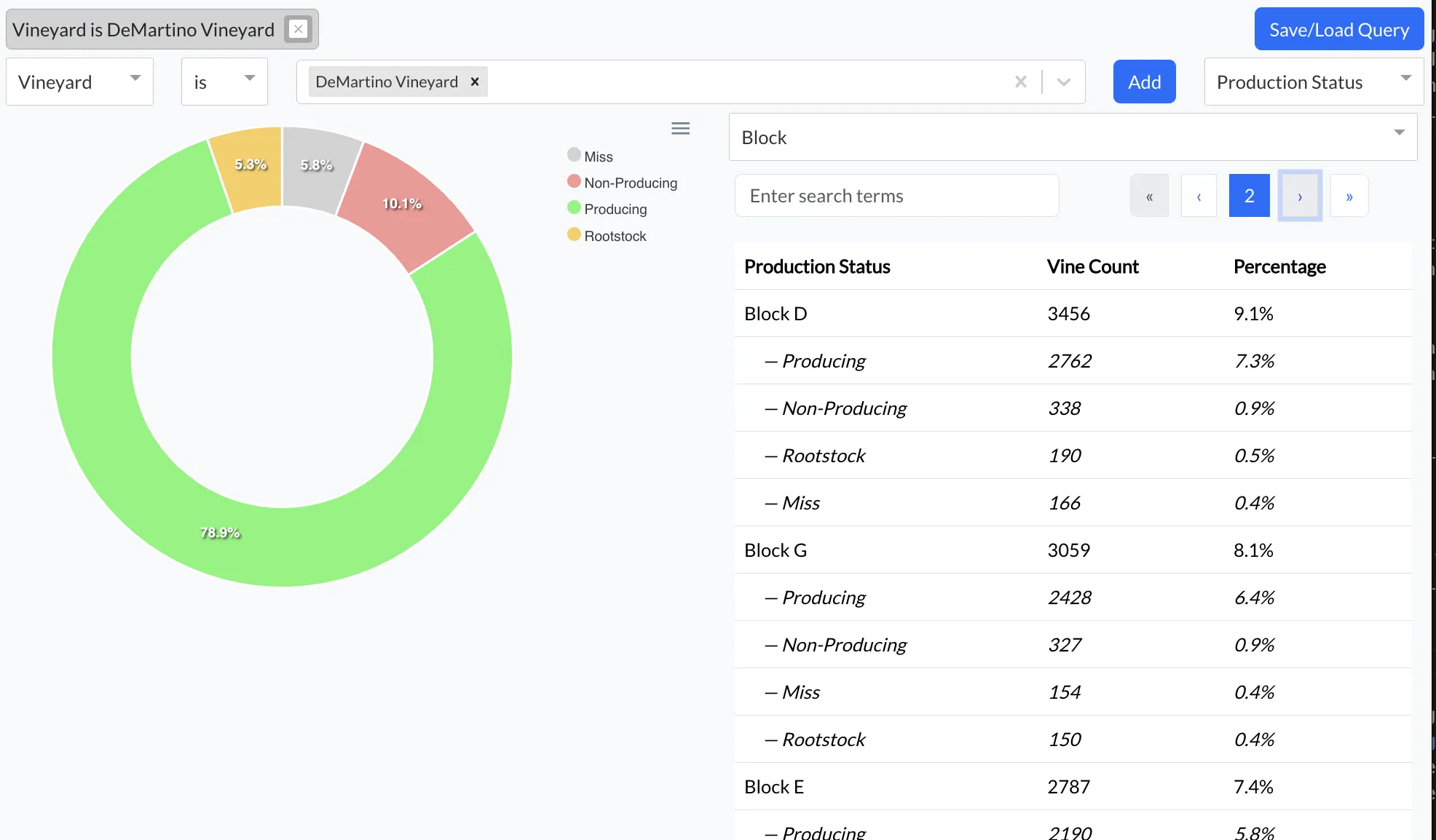
So not only do you speed up the scouting process (tapping a button on an app is faster than writing on a clipboard), but you eliminate all of the needless data entry, wrangling, and visualization costs. Add to that, your visibility into what's going on in the vineyard has increased 10x. You no longer need to dedicate 30% of a salaried viticulturist's time or hire an ArcGIS consultant to generate a map of virus or a pie chart of rootstocks, misses and producing vines.
<!-- related-reading -->